


In May of 2009, AmpleHarvest.org served exactly one community. The town next to mine.
I had just taken over our local community garden in West Milford, New Jersey, and like most gardeners, we did what gardeners do: we grew more than we could use. As the season started winding down, I learned a frustrating truth hiding in plain sight. Perfectly good, freshly harvested food was being left behind, not because people did not care or because they were lazy, but because they did not know what to do with it.
That is when the light bulb went on for me, and it still drives everything we do today: America does not have a “not enough food” problem. America has an information problem.
Home and community gardeners needed to know that, despite years of hearing “jars, cans, boxes, no fresh food,” they were actually allowed to donate fresh produce. They also needed to know which food pantries accept fresh produce, where those pantries are, and how to donate. Food pantries needed an easy way to say, “Yes, we accept fresh produce. Here’s when and how.”
That gap, missing information and misinformation, was a barrier that had been sitting there for decades. And once you see a barrier like that, you have two choices. You can shrug and walk away, or you can remove it and see what happens. We removed it, and then something remarkable happened: the solution started to scale.
The first 150 days that changed everything
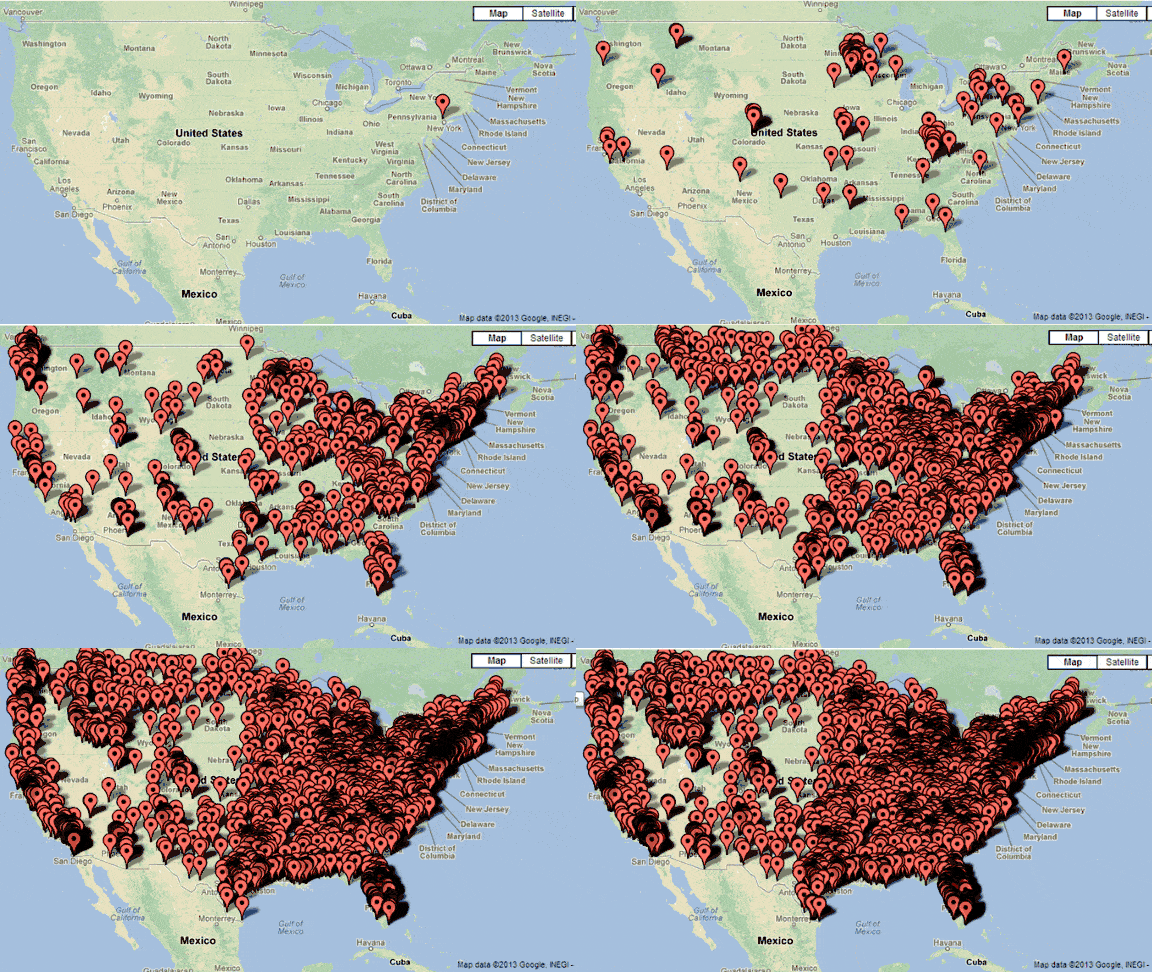
On day one, nearby St. Mary’s Food Pantry signed up. That may not sound dramatic until you understand what that meant. A pantry raised its hand and said, “We are here. Gardeners … come find us.” Then another pantry joined, and another, and another. There were no refrigerated trucks, no warehouse, no recruiting hundreds of volunteers, and no “let’s start in one city and see how it goes.” There was simply an ever-increasing number of food pantries learning about AmpleHarvest.org and joining so local gardeners could find them.
Then, 150 days after we started, on October 16, 2009, something happened that made me sit back and say, “Oh… this is real.” The 1,000th food pantry joined AmpleHarvest.org. That pantry was Rosie’s Place in Boston, Massachusetts, and October 16 just happened to be World Food Day. I did not plan that, and I could not have planned that, but it felt like the universe tapping us on the shoulder and saying, “Pay attention. This matters.”
From one community in May to 862 communities and 1,000 food pantries by World Food Day, 150 days later. That is what growth looks like when you remove a root-cause barrier.
Why AmpleHarvest.org scales
Most people assume solving hunger is fundamentally a logistics problem: more trucks, more warehouses, more hands moving food around. That is not what we do. AmpleHarvest.org is an award-winning nationwide nonprofit. We do not touch food. We are not a food recovery or distribution program. We do not build local facilities. We do not need offices in every state.
We remove the historic information barriers that prevented millions of home and community gardeners from donating their surplus harvests to nearby food pantries. Once that barrier is gone, the system starts doing what it was always capable of doing. Gardeners donate surplus harvests, food pantries receive fresh produce, families benefit, communities get healthier, and less food ends up wasted.
This is why AmpleHarvest.org can scale nationally without needing thousands of staff, endless volunteers, or a building with our name on it in every town. I often describe it this way: we are the conductor, not the musician. The gardeners make the music, the food pantries distribute it, and the community benefits. We simply make it possible for the existing stakeholders to coordinate and connect, and because an AmpleHarvest.org food pantry listing keeps working season after season, this is not a one-and-done impact. It is a sustained pipeline that can grow for years.
What 5,800 communities really means
5,800 communities is not just a big number for a dashboard. Every one of those communities has its own local ecosystem. It might be a downtown neighborhood, a suburban or rural town, or a Native American reservation. It is neighbors helping neighbors. It is food grown in a backyard or a community plot ending up at a local pantry in the same community, often donated within hours of being harvested.
And that matters because fresh food should not be a luxury when you are food insecure. Fresh fruits and vegetables are part of health. They are part of childhood development and adult wellbeing. They are part of dignity. They are part of community and cultural relevance. They reduce malnutrition and support better outcomes.
This is not only about hunger but also about health. And it is also about the planet. Food waste is not just “throwing food away.” It is throwing away the water used to grow it and the resources embedded in it. When surplus harvests are donated instead of wasted, communities reduce fresh food waste at the source while nourishing families, seniors, and individuals in need. And because fresh food donations are local and require no packaging, the footprint can be remarkably small.
That is what a practical, scalable solution looks like.
Why now
Why push for a major growth goal right now? Because families are feeling food prices. Food pantries are seeing growing demand. Millions of Americans are still gardening at levels we did not see a decade ago. And food waste and climate impacts are no longer abstract. This is a moment when a proven, scalable solution can grow faster than usual, if we fuel the growth.
The 10K goal
AmpleHarvest.org has a clear, measurable goal: reach 10,000 communities in the next 3 years. Doubling from about 5,800 to 10,000, especially in underserved, rural, and Tribal areas, is audacious, and it is also doable. The model scales, the need is massive, the solution is proven, and the constraint is specific: how fast we can reach and enroll more food pantries so gardeners can find them.
More communities mean more pantry visibility. More pantry visibility means more gardeners donating. More donations mean healthier food reaching families. The more communities, the healthier America becomes.
This 10K effort includes our core work, plus two programs designed to expand reach and accelerate adoption.
AmpleHarvest.org in Indian Country is an adaptation of our core model designed to support Tribal communities and food pantries serving Indigenous families, strengthening local access to fresh food while respecting food sovereignty. This is also an equity issue: rural and Tribal communities deserve the same easy access to fresh, locally grown food pathways as every suburban ZIP code.
Faith Fights Food Waste exists because 70% of food pantries are in a house of worship. We created this national program to engage clergy and faith communities of all faiths to teach why reducing food waste matters, and to encourage gardeners in congregations to donate surplus harvests to local food pantries. Learn more at http://www.FaithFightsFoodWaste.org.
How we will drive scaling and growth
We are not going to scale by hiring 200 people and opening offices. We are going to scale by accelerating awareness and enrollment using partnerships that already have trusted reach.
First, Feeding America and its member food banks. Food banks have close relationships with food pantries. This network can help accelerate pantry participation while respecting local realities and driving nationwide growth.
Second, the faith community. Faith leaders are trusted messengers. Houses of worship already organize around service, stewardship, and caring for neighbors. Faith Fights Food Waste gives them practical toolkits that make it easier to turn values into action.
Third, corporate partners who can move markets, not food. If you are a gardening company, a retailer, a consumer brand, or a national employer, you already have something precious: reach. You have customers, employees, and platforms that can activate millions of people. You also have a real opportunity to be associated with measurable impact tied to sustainability, community health, food waste reduction, and local resilience. This is the kind of CSR that is easy to explain and easy to participate in.
Fourth, social media and the power of one person sharing with another. After years of doing this, I have learned something: one trusted person telling another trusted person, “This is worth doing,” is often the most powerful marketing on earth. When you share what we do, you extend our reach. When you donate, you accelerate our growth. When you introduce us to a foundation or corporate partner, you help us scale faster.
Why foundations and corporate partners should care
Foundations and corporate partners often have the same core question: “Can this create lasting change at scale?” Yes. That is the point. AmpleHarvest.org is not a short-term patch. It is a structural fix to a long-standing gap in America’s food safety net.
It is also remarkably efficient. Our work is technology and outreach powered, which means impact can grow faster than overhead. And solutions that scale without requiring massive infrastructure are rare, and that makes them especially powerful. For corporate partners, this is highly activatable. It is not only awareness but also behavior change. It gives people a simple action: grow food, then donate surplus harvests locally. For foundations, it is measurable and durable. The network grows, and once a pantry is enrolled, the benefits continue season after season, year after year.
If you want to see the research and the “why we are different” framing in one place, check out http://www.AmpleHarvest.org/study and http://www.AmpleHarvest.org/definingthedifference.
If you want to help accelerate this
If you care about hunger, health, sustainability, or smart solutions that scale, here are three simple ways to help.
First, donate to AmpleHarvest.org. Your financial support accelerates our scaling and growth to 10,000 communities. It helps us reach and enroll more food pantries, expand rural and Tribal coverage, and grow national impact.
Second, introduce us to a foundation or corporate partner. If you know someone who funds scalable national solutions, please make the introduction. One introduction can change our growth curve.
Third, share this on LinkedIn. It sounds small, but it is not. It helps reach the exact people who can accelerate this effort: partners, funders, and doers.
We started in one community. In 150 days, we were in 862 communities, and more than 1,000 food pantries had joined. Today we are in about 5,800 communities. Now we are going for 10,000.
If you believe America can be healthier and communities can be stronger through smarter systems rather than bigger logistics, I invite you to join us. Let’s scale something that should have been obvious all along. Let’s grow the network. Let’s double the reach. Because no one should have to choose between hunger and health, not when part of the solution is already growing in backyard and community gardens across America.


